Program · Accepted, Journal of Fluid Mechanics研究项目 · 已被 Journal of Fluid Mechanics 接收
Tensor-Geometry-Activated Spectral Energy Transfer at Reynolds Numbers of Order Unity in Two-Dimensional Flows
二维流动中由张量几何激活的、雷诺数为 O(1) 量级的谱能量传递
Ziyue Yu, Xinyu Si, Lei Fang — Accepted, Journal of Fluid Mechanics
Ziyue Yu, Xinyu Si, Lei Fang — 已被 Journal of Fluid Mechanics 接收
1. Motivation
1. 研究动机
For over a century, Navier–Stokes turbulence — that chaotic, multiscale state of motion — was understood to appear only when inertial forces greatly exceed dissipative ones, i.e. at Reynolds numbers Re ≫ 1. Low-Reynolds-number flows were assumed to be smooth, reversible, laminar states governed by a linear balance between forcing and viscous/frictional dissipation, and were dismissed as "dynamically trivial."
一个多世纪以来,人们一直认为 Navier–Stokes 湍流——那种混沌、多尺度的运动状态——只有在惯性力远大于耗散力时才会出现,也就是雷诺数 Re ≫ 1 的情形。低雷诺数流动则被认为是光滑、可逆的层流状态,由驱动与粘性/摩擦耗散之间的线性平衡所支配,长期被视为“动力学上平凡”而不受重视。
A defining signature of turbulence is the spectral energy flux: the continuous transfer of energy across scales (a forward cascade in 3D, an inverse cascade in 2D). This work poses a bold question and answers it in the affirmative: must this turbulence-like energy transport rely on inertial dominance? The authors argue that it need not — by deliberately controlling the geometric orientation of the tensors in the flow, one can excite an energy flux comparable to weak turbulence within a Re ~ O(1) laminar flow.
湍流的一个标志性特征是 谱能量通量:能量在不同尺度间的持续传递(三维中是正向级串,二维中是反向级串)。本研究提出并肯定地回答了一个大胆的问题:这种类湍流的能量输运,是否必须依赖惯性的主导?作者认为并不需要——通过刻意调控流动中张量的几何取向,就能在 Re ~ O(1) 的层流中激发出与弱湍流相当的能量通量。
2. Theoretical Framework and Method
2. 理论框架与方法
Core theory. The authors reinterpret the inter-scale energy flux as a form of "mechanical work": the inner product between a stress tensor τ (analogous to a force) and the large-scale strain-rate tensor S (analogous to a displacement). In 2D, the energy flux can be written as
核心理论。 作者把尺度间的能量通量重新诠释为一种“机械功”:应力张量 τ(类比于力)与大尺度应变率张量 S(类比于位移)之间的内积。在二维中,能量通量可写为
Π^(L) = −2 |S| |τ| cos(2θ)
Π^(L) = −2 |S| |τ| cos(2θ)
where θ is the angle between the stretching directions of the stress and strain-rate tensors. This expression shows that the geometric alignment of the two tensors governs not only the direction of energy transfer, but also its magnitude. When θ < π/4 energy flows toward large scales (inverse cascade); when θ > π/4 it flows toward small scales; at θ = π/4 there is no net flux. In ordinary low-Re flows, |S| and |τ| are small and θ tends toward π/4, so the energy flux nearly vanishes and the flow appears laminar. The key insight: applying a small, directionally biased perturbation (supplying an additional stress tensor τ) that aligns with the existing strain-rate field can "activate" this stress–strain-rate energy pathway at low Re, while the perturbation power stays small and the flow remains in the low-Re regime.
其中 θ 是应力张量与应变率张量拉伸方向之间的夹角。这一表达式表明,两个张量的几何对齐不仅决定了能量传递的方向,也决定了它的大小。当 θ < π/4 时,能量流向大尺度(反向级串);当 θ > π/4 时,能量流向小尺度;当 θ = π/4 时,则没有净通量。在普通的低雷诺数流动中,|S| 和 |τ| 都很小,且 θ 趋向 π/4,因此能量通量几乎消失,流动呈现层流状态。关键的洞见在于:施加一个微小的、有方向偏置的扰动(即额外提供一个应力张量 τ),使其与已有的应变率场对齐,就能在低雷诺数下“激活”这条应力–应变率的能量通道,而扰动本身的功率仍然很小,流动也依旧保持在低雷诺数区间。
Experimental platform. An electromagnetically driven thin-layer flow: a layer of 14% NaCl brine (roughly 96.5 × 83.8 × 0.5 cm³) sits above a permanent-magnet array and is driven by the Lorentz force produced by the magnetic field and a DC current. Two large-scale base flows can be organized — a shear flow and a cellular flow — both with well-organized large-scale strain-rate structure.
实验平台。 一个电磁驱动的薄层流动:一层 14% 的 NaCl 盐水(尺寸约 96.5 × 83.8 × 0.5 cm³)置于永磁体阵列之上,由磁场与直流电产生的洛伦兹力驱动。可以组织出两种大尺度基本流——剪切流与胞状流——二者都具有组织良好的大尺度应变率结构。
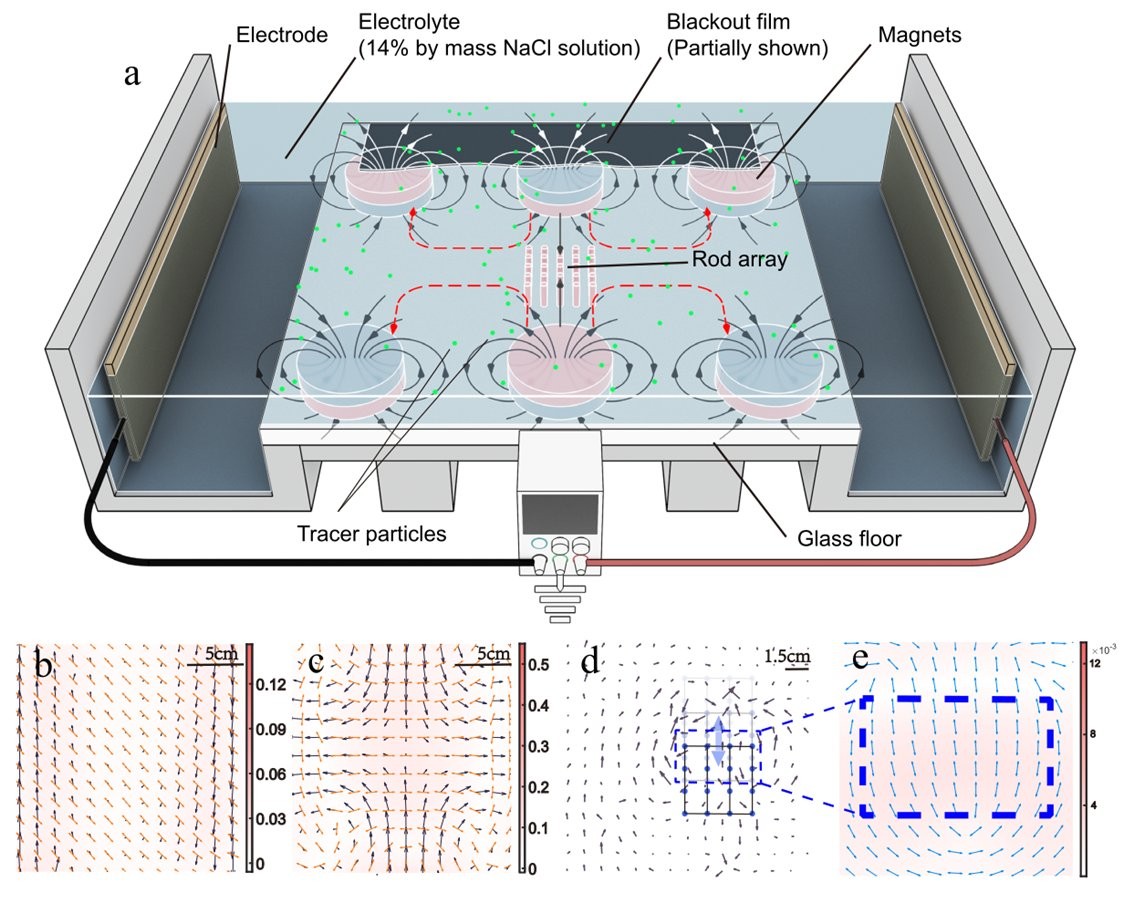
The apparatus (a) and the measured background flow and perturbation fields (b–e), obtained by particle tracking velocimetry.
实验装置(a)以及通过粒子追踪测速(PTV)测得的背景流场与扰动场(b–e)。
Perturbation method. A 4×4 rod array driven by linear actuators oscillates periodically to inject small-scale perturbations, with a speed roughly 2.5× the background RMS velocity — enough to activate the stress–strain interaction without dominating the base flow. By precisely presetting the mechanical angle α between the rod motion direction and the principal background strain direction (e.g. α ≈ 0, π/4, π/2), the energy flux is actively tuned. The flow is recorded with an industrial camera and analyzed by particle tracking velocimetry (PTV). A Reynolds-number definition suited to friction-dissipation-dominated systems is used, Re = u²/(ανL).
扰动方法。 一个由直线电机驱动的 4×4 杆阵列周期性振荡,以注入小尺度扰动,其速度约为背景均方根速度的 2.5 倍——足以激活应力–应变相互作用,又不会压过基本流。通过精确预设杆运动方向与背景主应变方向之间的机械夹角 α(例如 α ≈ 0、π/4、π/2),即可主动调节能量通量。流动由工业相机记录,并用粒子追踪测速(PTV)进行分析。研究采用了一个适用于摩擦耗散主导系统的雷诺数定义,Re = u²/(ανL)。
3. Main Results
3. 主要结果
- Significant energy-flux enhancement at Re ~ O(1). In both the shear and cellular flows, the α ≈ 0 and α ≈ π/2 configurations both produced energy-flux magnitudes amplified up to ~300×, reaching levels usually classed as "weak turbulence" — even though the flow's kinetic energy is extremely low and Re is only of order one.
- Sustained multiscale transfer. The energy flux is nearly constant over a broad range of scales (~0.2–1.2 in normalized scale), indicating a persistent transport across all scales rather than a local response confined to the perturbation scale — much like classical turbulence dynamics.
- Re ~ O(1) 时能量通量显著增强。 在剪切流和胞状流中,α ≈ 0 与 α ≈ π/2 两种配置都使能量通量的量级放大了最多约 300 倍,达到通常被归为“弱湍流”的水平——尽管此时流动的动能极低,雷诺数也只有量级为一。
- 持续的多尺度传递。 能量通量在很宽的尺度范围内(归一化尺度约 0.2–1.2)几乎保持恒定,表明这是一种跨越所有尺度的持续输运,而非局限于扰动尺度的局部响应——与经典湍流动力学十分相似。
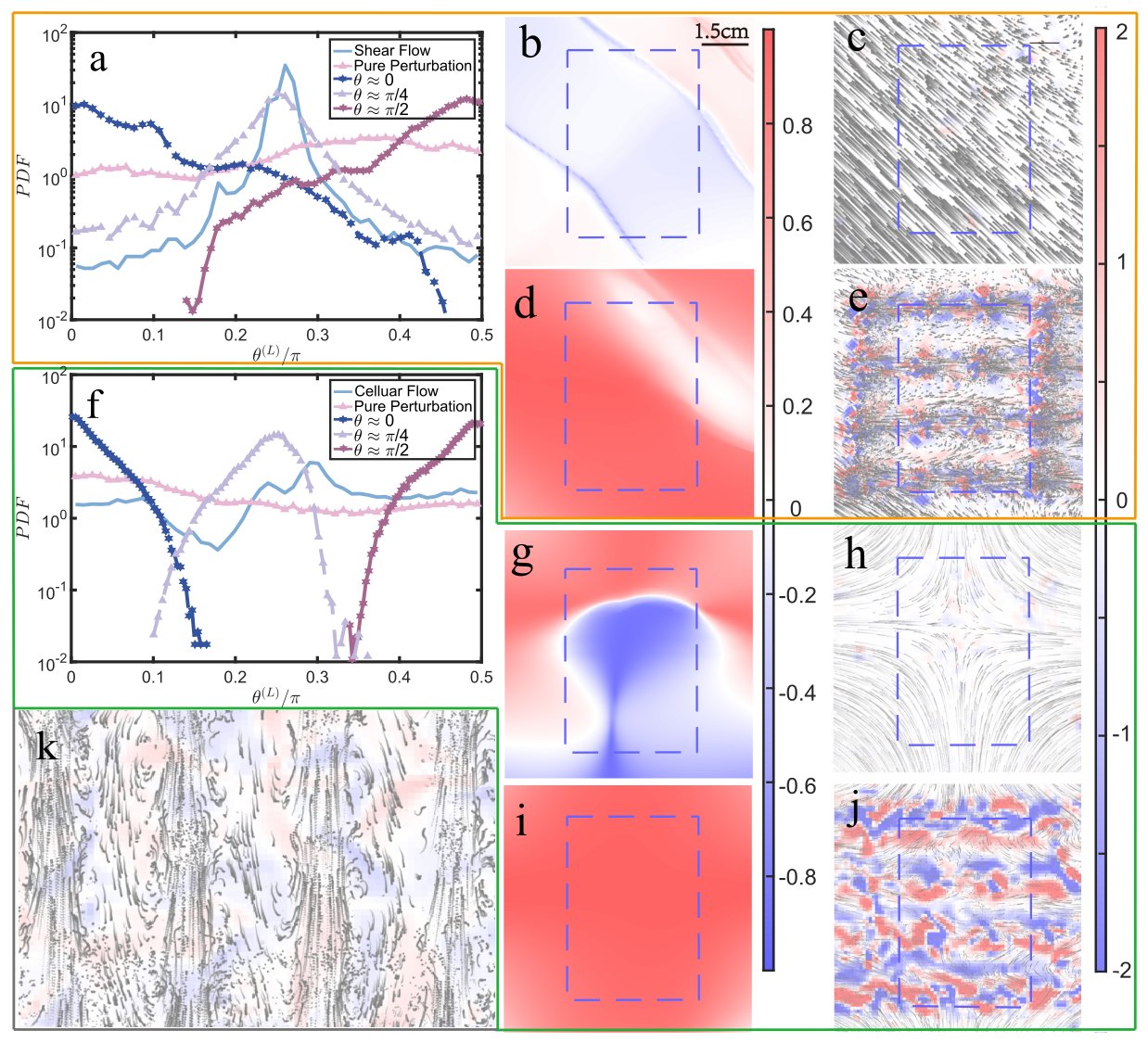
Stress–strain orientation statistics and physical-space trajectories. Unperturbed flows (panels c, h) are smooth and laminar; the perturbed flows (panels e, j) are chaotic with turbulence-like vorticity — at essentially the same, order-one Reynolds number.
应力–应变取向统计与物理空间中的轨迹。未扰动流动(图 c、h)光滑而层流;受扰动流动(图 e、j)则呈现混沌轨迹与类湍流的涡量——而两者的雷诺数基本相同,都是量级为一。
- Mechanism breakdown. The enhancement arises from two cooperating mechanisms: (i) the small-scale directional perturbation greatly raises the stress magnitude |τ|; (ii) the appropriate mechanical angle aligns the stress and strain-rate tensors (θ → 0 or π/2), raising the flux efficiency cos(2θ) from near zero to close to ±1.
- Crossing the weak-turbulence threshold. On an energy-flux vs. system-kinetic-energy plot, the perturbed flow crosses the weak-turbulence threshold line at kinetic-energy levels far below those reported in the literature — showing the conclusion is independent of the specific Reynolds-number definition.
- 机理拆解。 这种增强来自两个协同作用的机制:(i)小尺度的方向性扰动大幅提高了应力量级 |τ|;(ii)合适的机械夹角使应力张量与应变率张量对齐(θ → 0 或 π/2),把通量效率 cos(2θ) 从接近零提升到接近 ±1。
- 越过弱湍流门槛。 在能量通量对系统动能的图上,受扰动流动在远低于文献报道的动能水平上就越过了弱湍流门槛线——说明这一结论与具体的雷诺数定义无关。
4. Conclusion and Outlook
4. 结论与展望
This work demonstrates that the turbulent energy flux long thought to require strong inertia can instead be actively built and sustained within a nominally laminar Re ~ O(1) flow through directed control of tensor geometry. It reveals a general mechanism — one can tap directly into the stress–strain-rate energy pathway that underpins classical turbulence, without inertial dominance.
本研究表明,长期以来被认为需要强惯性才能出现的湍流能量通量,其实可以通过对张量几何的定向调控,在一个名义上层流的 Re ~ O(1) 流动中被主动构建并维持。它揭示了一种普适的机制——无需惯性主导,就能直接调用支撑经典湍流的那条应力–应变率能量通道。
The open questions the authors leave: to what extent does this "tensor-geometry-activated" cross-scale energy transfer blur the classical laminar–turbulent boundary? And how should such artificially controlled low-Re flows be understood within a broader turbulence framework? Potential applications include non-inertia-dominated settings such as microfluidics and biological systems, and the framework extends naturally to 3D (see supplementary material; the difference is that 3D has three principal directions).
作者留下的开放问题是:这种“张量几何激活”的跨尺度能量传递,在多大程度上模糊了经典的层流–湍流界限?又该如何在更广义的湍流框架下理解这类人工调控的低雷诺数流动?潜在的应用场景包括微流控与生物系统等非惯性主导的环境;该框架也能自然地推广到三维(见补充材料;区别在于三维有三个主方向)。